
Yorkie and Morkie Health Testing: Records to Ask a Breeder For
Yorkie and Morkie health testing means evaluating the parent dogs for conditions listed for their breeds and keeping the results as written records. A listed test is a recommendation, not proof that any given dog was tested.
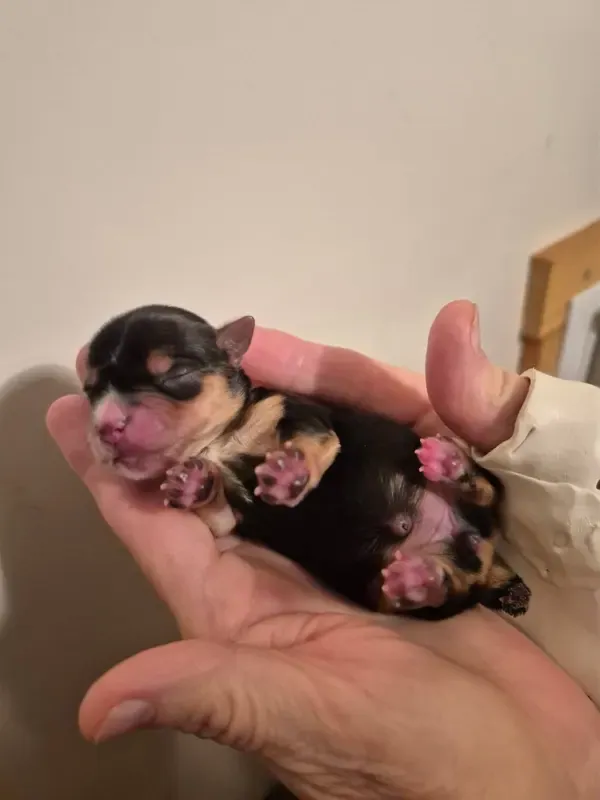
Tests Listed for the Yorkshire Terrier
Health testing and records start with three requests for each parent dog.
- Written results for each parent
- Which test was done and who performed it
- The date and the document
The American Kennel Club (AKC) lists two evaluations for the Yorkshire Terrier in its Toy Group health testing requirements. These are recommendations for the breed, so they tell you what to ask about, not what any one dog has had done.
- Patella evaluation: an examination of the kneecap, also called a patellar luxation evaluation, which looks at whether the kneecap stays in place.
- Ophthalmologist evaluation: an eye examination performed by a veterinary eye specialist.
Your veterinarian is the right source for any question about what a result means for a particular dog.
Health Testing for Morkie Parent Breeds
PetPlace describes a Morkie as a cross of a Maltese and a Yorkshire Terrier. That describes the cross in general. It does not tell you which breeds a particular puppy's own parents are. Ask which dogs are the parents, and ask for the records for each of them.
AKC lists the Maltese entries differently from the Yorkshire Terrier entries. The Maltese entries are patella evaluation, cardiac exam and serum bile acids. Check the AKC Toy Group page for the Maltese list, and do not assume the Yorkshire Terrier tests apply.
The sources used here describe no breed-specific testing standard for the Morkie cross. Ask about each parent dog separately, and treat a listed test as something to ask about until you hold a written result for it.
How to Read Health-Test Records
Work through a record one step at a time, and keep each answer in writing.
- Parent identification: ask which dogs were tested, naming each parent by name or ID.
- Test name: ask which test was done, such as a patella evaluation or an ophthalmologist evaluation.
- Evaluator: ask who performed or evaluated the test.
- Date: ask when the test was done.
- Document: ask for the written result, not a summary of it.
- Match: check that the name or ID on the record matches the dog you were told about.
A record shows what was evaluated, by whom and when. It does not show how any puppy will turn out.
The table maps each test AKC lists for the Yorkshire Terrier and the Maltese to the written result you can ask for. It is a request checklist, not a clinical interpretation, so take any question about what a result means to your veterinarian.
Swipe or scroll sideways to read all columns.
| Test listed by AKC | Parent breed | Ask for | Which parent it identifies | The limited fact it documents | What it does not document |
|---|---|---|---|---|---|
| Patella evaluation | Yorkshire Terrier | The written patella evaluation result | The parent named or identified on the record | That this evaluation was done on that dog, by the named evaluator, on the stated date | Any other test, or how a puppy will turn out |
| Ophthalmologist evaluation | Yorkshire Terrier | The written ophthalmologist evaluation result | The parent named or identified on the record | That this eye evaluation was done on that dog, by the named evaluator, on the stated date | Any other test, or how a puppy will turn out |
| Patella evaluation | Maltese | The written patella evaluation result | The parent named or identified on the record | That this evaluation was done on that dog, by the named evaluator, on the stated date | Any other test, or how a puppy will turn out |
| Cardiac exam | Maltese | The written cardiac exam result | The parent named or identified on the record | That this exam was done on that dog, by the named examiner, on the stated date | Any other test, or how a puppy will turn out |
| Serum bile acids | Maltese | The written serum bile acids result | The parent named or identified on the record | That this test was done on that dog, on the stated date, with the result written on the record | Any other test, or how a puppy will turn out |
A Morkie's parents may be one dog of each breed, so you may need the Maltese rows for one parent and the Yorkshire Terrier rows for the other. Confirm the actual parent dogs first, then match each record to the right parent.
A DNA panel screens for specific genetic conditions. It does not replace evaluations such as a patella or eye exam, so a DNA panel is not the same as all health testing.
To use these steps while comparing more than one breeder, see how to choose a Yorkie or Morkie breeder.
What This Site Can and Cannot Say
General guidance applies to dogs in general, so the records for a specific dog come from the breeder who owns that dog. To ask Yadkinyorkies & Morkies for records, call (336) 488-4717 and name the parent dogs and the tests you want to ask about.
You can also find other ways to reach us on the contact page.
Common Questions
Can a puppy buyer rely on a DNA panel alone?
No. Ask which conditions the panel covered, then ask separately which evaluations were done for each parent, because the first answer does not answer the second. Your veterinarian can explain what a given result means.
What if a breeder will not share records?
Treat the records as not yet confirmed. You can ask again in writing, wait until they are available, or compare other breeders whose answers are specific and written.
Call With Questions
Have ready the names of the parent dogs you want to ask about and the records you want to see for each. Call (336) 488-4717 with questions, or read about Yorkie puppies and Morkie puppies from Yadkinyorkies & Morkies.