
Identifying the breed
Appearance can vary, so a puppy's looks alone do not confirm its breed. Parentage records are the verifiable basis, and you can learn what to request in how to choose a Yorkie or Morkie breeder.
Choose a Yorkie if you prefer a known breed standard and a Morkie if you accept more variability, and see parent records either way. A Yorkie is a purebred Yorkshire Terrier, while a Morkie is a Maltese and Yorkshire Terrier mix that varies more in size and coat, according to PetPlace.
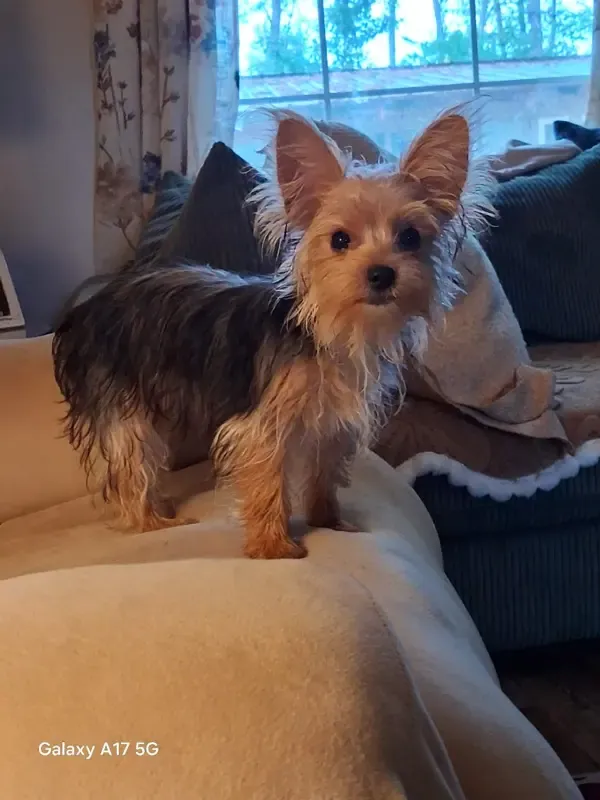
A Yorkie vs Morkie comparison is easiest when you read each row as a range, not a promise. Variation within each is large, so the last column shows how to check.
Swipe or scroll sideways to read all columns.
| Attribute | Yorkie | Morkie | How to verify |
|---|---|---|---|
| Breed makeup | A purebred Yorkshire Terrier | A cross of a Maltese and a Yorkshire Terrier | Ask for the parent dogs' breeds in writing |
| Size | Small dog; individual size varies | Adults commonly about 6 to 10 inches tall and about 4 to 8 pounds, with some outside that range (PetPlace) | Ask for documented parent sizes |
| Coat and grooming | Needs ongoing brushing, coat care and professional grooming support (AKC) | Coats vary, so care follows the individual dog | Ask about both parents' coats |
| Shedding and allergies | No guarantee; individual dogs differ | No guarantee; no dog is completely hypoallergenic (PetPlace) | Spend time around the dogs and note your own reaction |
| Temperament | Varies by individual dog | Varies by individual dog (PetPlace) | Ask about the parents' temperaments |
| Health-testing considerations | AKC lists tests for the Yorkshire Terrier; a listed test is a recommendation, not proof a dog was tested | AKC lists tests by breed, and no testing standard for the cross is stated; what applies depends on the actual parent dogs | Ask which tests were done for each actual parent dog; see health testing and records |
| Records to request | Written results for each parent dog | Written results for each parent dog | Match each record to the named dog |
Puppies vary because each inherits a different mix of traits from its parents, and a Morkie is a cross, so its parents can differ more in size and coat.
Appearance can vary, so a puppy's looks alone do not confirm its breed. Parentage records are the verifiable basis, and you can learn what to request in how to choose a Yorkie or Morkie breeder.
Labels such as "teacup" are not a promise of adult size. PetPlace states that "teacup" is not an officially recognized breed designation and that extremely small size can come with additional health concerns, so ask for documented parent sizes.
Both breeds are small dogs, and PetPlace notes that temperament varies by individual. Weigh the fit and the challenges together.
Ask your veterinarian about any health or care question.
Individual dogs differ, and no breed or cross is guaranteed to suit an allergy. Ask a breeder about the parents' coats, and spend time around the dogs to learn how you react.
Match your household to one of these three rules, and read each one as a condition.
Have ready the size, coat and grooming expectations you want, who and what else lives in your home, and the parent records you want to ask about. Call Yadkinyorkies & Morkies at (336) 488-4717 with questions, or use the contact page.